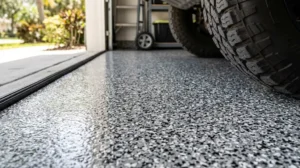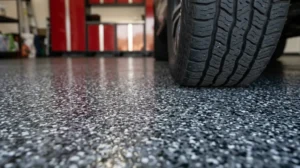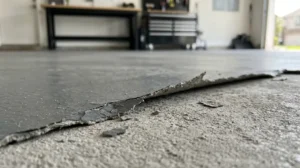
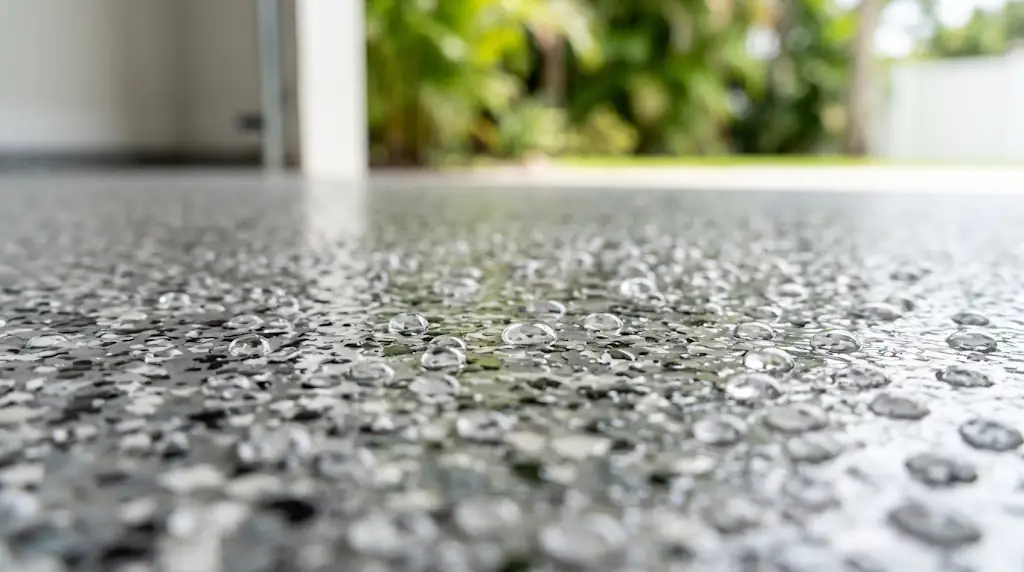
Standard epoxy flooring cannot withstand Treasure Coast humidity and moisture without an integrated moisture vapor barrier, failing rapidly when subterranean water vapor creates hydrostatic pressure under the concrete slab. However, a multi-layer commercial system engineered with an ASTM F3010-compliant moisture-mitigation epoxy primer resists up to 100% relative humidity, permanently bonding to coastal Florida concrete despite high groundwater tables and tropical air saturation.
The Physics of Concrete Moisture on the Treasure Coast
Concrete is a porous, capillary-dense material that acts like a hard sponge. Along Florida’s Treasure Coast—spanning Martin, St. Lucie, and Indian River counties—concrete garage slabs endure continuous moisture exposure from two opposing directions:
- Sub-slab hydrostatic pressure: High coastal water tables force liquid groundwater upward through microscopic concrete capillaries via capillary action.
- High ambient dew points: Subtropical air saturation and sustained relative humidity above 80% drive moisture into the open surface pores of the concrete.
When warm, humid air meets a cooler concrete slab, condensation occurs. When unsealed concrete pulls moisture from the damp subgrade below, the moisture evaporates harmlessly into the open room.
The moment a non-breathable resin coating seals the top surface, that natural evaporation stops. Moisture vapor collects directly beneath the resin membrane. Without a dedicated mitigation barrier, vapor accumulation creates hydrostatic pressure exceeding 25 to 30 pounds per square inch (psi). This pressure overcomes the tensile strength of standard epoxy, popping the coating off the concrete in sheets.
How Moisture Destroys Standard Coatings
Applying standard big-box epoxy paint or unmitigated coatings in coastal Florida leads to three documented mechanical failures:
| Failure Mode | Visual Symptom | Root Cause |
| Osmotic Blistering | Fluid-filled bubbles and pockets under the coating film | Soluble mineral salts trapped beneath the epoxy pull water through the coating via osmosis. |
| Efflorescence Debonding | White, powdery chalk beneath cracked or lifting flakes | Water dissolving calcium hydroxide from the concrete reacts with atmospheric carbon dioxide, crystallizing under the base coat. |
| Amine Blushing | Dull, oily, or waxy yellow film on the curing surface | High ambient humidity during installation forces atmospheric water to react with raw amine curing agents before polymer cross-linking finishes. |
Moisture Thresholds: When Concrete Fails Testing
Professional installers quantify slab moisture before applying resins. Visual inspection never determines whether a slab is dry enough for coating. Testing utilizes two industry-standard protocols:
1. ASTM F2170: In-Situ Relative Humidity (RH) Probes
Technicians drill holes into the slab to 40% of its total thickness, insert electronic sleeves, and measure internal relative humidity after 24 hours of equilibration.
- Standard epoxy threshold: Maximum 75% internal RH.
- Treasure Coast baseline: Garages in Port St. Lucie and Stuart consistently test between 80% and 95% internal RH year-round due to the shallow water table.
- Mitigation threshold: Commercial vapor-barrier primers withstand up to 99% or 100% internal RH without debonding.
2. ASTM F1869: Anhydrous Calcium Chloride MVER
This protocol measures the Moisture Vapor Emission Rate (MVER) coming off the slab surface over a 60- to 72-hour period.
- Standard epoxy threshold: 3.0 lbs of vapor per 1,000 square feet per 24 hours.
- Treasure Coast average: Unsealed coastal slabs routinely produce emissions of 6.0 to 14.0 lbs per 1,000 square feet per 24 hours.
- Mitigation threshold: ASTM F3010 systems control vapor emissions up to 20.0 to 25.0 lbs per 1,000 square feet.
4 Moisture-Proof Engineering Steps for Coastal Slabs
Installing high-performance coatings that survive Treasure Coast weather requires four sequential mechanical and chemical controls:
Diamond Mechanical Grind (CSP 2–3) ➔ 100% Solids Epoxy Moisture Barrier ➔ Full Vinyl Broadcast ➔ Aliphatic Polyaspartic Topcoat
1. Mechanical Grinding Over Acid Etching
Acid etching relies on pouring muriatic acid and water onto the concrete. Pouring liquid onto a high-moisture Florida slab introduces gallons of additional water directly into the aggregate.
Professional installation requires dry mechanical grinding using planetary rotary diamond tooling attached to industrial HEPA vacuums. Diamond grinding removes weak surface laitance, levels high points, and creates a clean concrete surface profile benchmarked by the International Concrete Repair Institute (ICRI CSP 2 or 3).
2. 100% Solids Moisture Vapor Barrier Base
The critical defensive layer is a specialized 100% solids, zero-VOC epoxy primer formulated to react within wet concrete capillaries.
Unlike standard waterborne base coats that evaporate away thin, a true moisture mitigation primer penetrates the open pores, forms cross-linked polymer chains deep in the concrete matrix, and cures into an impermeable glass-like sheet. It provides tensile pull-off bond strength exceeding 400 psi—higher than the concrete’s internal structural strength.
3. Full Flake Broadcast Layer
A dense broadcast of vinyl chips provides an additional structural interlock over the base coat. The multi-colored flake matrix dissipates impact shock, prevents micro-fracturing, and conceals cosmetic slab hairline movement caused by Florida’s seasonal wet-and-dry soil expansion.
4. Fast-Curing Polyaspartic Clear Topcoat
While epoxy excels as a concrete-bonding primer, high ambient humidity during the curing window can create amine blush on standard clear epoxies. Polyaspartic polyurea chemistries thrive in higher ambient moisture environments. They cure rapidly, will not blush or turn amber under direct coastal UV rays, and seal the entire surface against liquid water, chemical spills, and motor vehicle fluids.
Local Elevation and Water Table Variations Across Our Service Area
Groundwater risks fluctuate depending on local topography, canal networks, and proximity to the Atlantic Ocean:
- Port St. Lucie & Fort Pierce (St. Lucie County): Homes near the North Fork of the St. Lucie River and dense master-planned subdivisions in Becker Ridge, Gatlin, and Tradition sit on sandy, poorly draining subgrades. Slabs poured without modern 15-mil poly vapor retarders require dedicated ASTM F3010-grade moisture primers.
- Stuart & Palm City (Martin County): Homes near the South Fork and St. Lucie Inlet feature older construction stock with porous slabs and no underslab vapor barriers. High seasonal rains saturate the local aquifer, causing rapid pressure spikes beneath the concrete.
- Jensen Beach & Hobe Sound: Properties near the Indian River Lagoon and barrier islands experience salt-fog air intrusion and wind-driven rain. Moisture-mitigating base coats prevent subterranean intrusion, while aliphatic topcoats prevent surface degradation from airborne salt chlorides.
- Vero Beach (Indian River County): Oceanfront and mainland residential communities with limestone-dense aggregate require mechanical diamond grinding to open tight aggregate pores before laying down deep-penetrating moisture resins.
Protect Your Concrete from Florida Groundwater
Concrete in Florida’s coastal climate requires engineering that accounts for high humidity and sub-slab hydrostatic pressure from day one. Port St. Lucie Epoxy Flooring tests slab vapor emission rates, grinds surfaces with industrial diamond equipment, and installs moisture-mitigating floor systems built to withstand the toughest coastal conditions. If your garage shows signs of peeling, bubbling, or efflorescence, schedule a floor inspection through our contact page.