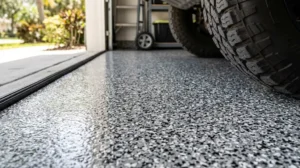
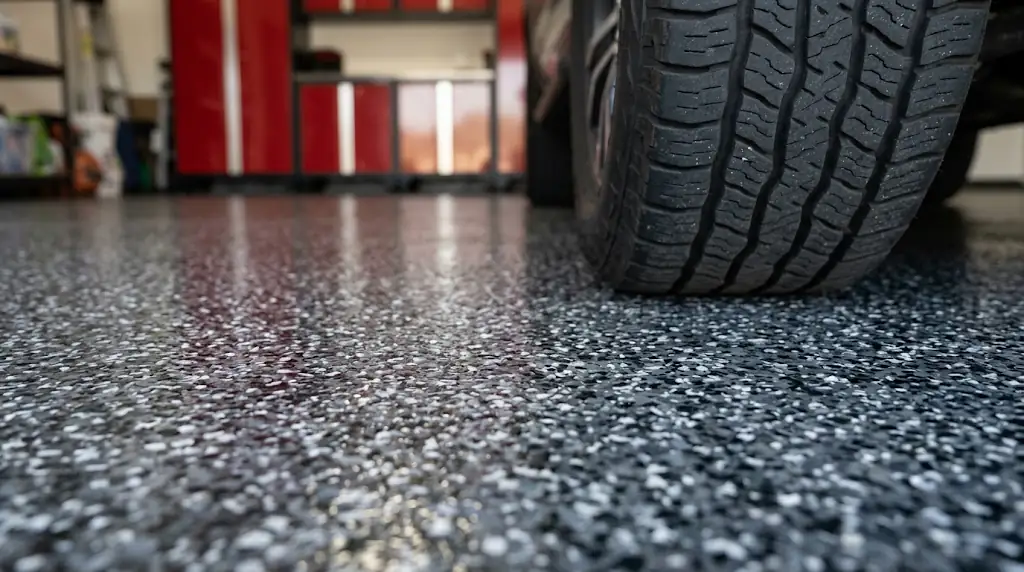
Prevent hot tire pickup by mechanically diamond grinding concrete to an ICRI CSP 2 or 3 profile and sealing the floor with an aliphatic polyaspartic topcoat rated for temperatures above 300°F. This industrial coating barrier stops heated tire plasticizers from chemically bonding to the resin, eliminating the thermal softening and delamination caused by high-speed driving on South Florida highways.
What Causes Hot Tire Pickup?
Hot tire pickup is a thermo-chemical bond failure that occurs when hot automotive tire rubber contacts low-grade floor coatings. It is not caused by tire friction or tread grip pulling on the floor; it is caused by chemical migration and thermal softening.
Automotive tires contain synthetic rubber polymers blended with petroleum-based oils called plasticizers. Tire manufacturers formulate rubber with these plasticizers to maintain flexibility, traction, and structural integrity under high highway speeds and friction.
When you drive on Treasure Coast roadways during the spring and summer months, your tires absorb extreme heat:
- Asphalt surface temperatures along Interstate 95, Florida’s Turnpike, and US Highway 1 regularly hit 140°F to 160°F between May and October.
- Tire friction raises internal tire core temperatures past 135°F to 150°F during standard highway commutes between Port St. Lucie, Stuart, and West Palm Beach.
When a vehicle returns home and pulls into a residential garage, the hot tires rest directly on the floor coating. If the garage is coated with a standard hardware store epoxy paint or retail waterborne sealer:
- Thermal Softening: The intense heat from the parked tires transfers into the coating film, raising the resin past its glass transition temperature ($T_g$) and softening the polymer chains.
- Plasticizer Migration: Volatile plasticizers leach out of the heated tire rubber directly into the softened coating, causing a cross-chemical weld between the tire tread and the floor.
- Tensile Shearing: As the vehicle sits parked overnight, the tires cool and contract. The bonded rubber pulls upward with immense tensile force. Because the thin coating possesses weak adhesion to the concrete, the tire tears the coating off the slab, exposing bare concrete in the exact footprint of the four tires.
Hot Tire Resistance by Floor Coating Chemistry
Not all coatings respond to vehicle heat the same way. The chemical composition and resin density dictate whether a floor resists tire plasticizers or tears off within weeks:
| Coating Chemistry | Heat Deflection Temp | Plasticizer Penetration Resistance | Surface Prep Required | Hot Tire Pickup Risk in South Florida |
| Acrylic / Latex Concrete Paint | Under 110°F | Zero (Porous waterborne film) | Acid etch / Pressure wash | Guaranteed Failure (1 to 4 weeks) |
| Retail DIY Water-Based Epoxy | 120°F – 130°F | Low (Solvents leave open micropores) | Muriatic acid wash | High Failure Rate (3 to 12 months) |
| Standard 100% Solids Epoxy | 140°F – 160°F | Moderate (Resists light local driving) | Mechanical diamond grind | Moderate Risk (Fails under heavy I-95 commutes) |
| Commercial Hybrid (Epoxy Base + Polyaspartic Top) | 300°F+ | Total (Dense, cross-linked aliphatic barrier) | Industrial Diamond Grind (ICRI CSP 2–3) | Zero Risk (Permanent thermal stability) |
4 Engineering Steps to Permanently Eliminate Hot Tire Pickup
Preventing hot tire delamination requires matching proper mechanical preparation with high-heat chemical engineering. Skipping any of these four steps leaves the coating vulnerable to thermal failure.
Industrial Diamond Grind (CSP 2–3) ➔ 100% Solids Moisture Primer ➔ Full Vinyl Flake Matrix ➔ Aliphatic Polyaspartic Clear Armor
1. Mechanical Planetary Diamond Grinding
Chemical acid etching cannot profile concrete adequately to resist the shear forces of cooling tires. Slabs across Martin, St. Lucie, and Indian River counties must undergo dry planetary diamond grinding using heavy industrial floor machines equipped with vacuum HEPA filtration.
Diamond grinding mechanically strips away weak surface laitance (the brittle top layer of cured concrete cream) and cuts open the hard aggregate pores beneath. This establishes a uniform Concrete Surface Profile 2 or 3 benchmarked by the International Concrete Repair Institute. When the base coat is applied to a diamond-ground slab, the resin flows deep into open concrete capillaries, achieving a mechanical anchor exceeding 400 psi under ASTM D4541 tensile adhesion tests.
2. High-Strength Moisture Vapor Base Coat
Even if a topcoat resists hot tires, ground moisture can break the bond from beneath. The Treasure Coast’s shallow water table creates continuous upward hydrostatic pressure.
A high-performance floor system requires a 100% solids epoxy moisture vapor barrier primer compliant with ASTM F3010. This primer locks into the concrete pores, withstands up to 20 lbs of moisture vapor emission per 1,000 square feet, and provides a rigid substrate anchor that refuses to lift when external mechanical stresses pull from the top.
3. Full Decorative Vinyl Flake Matrix
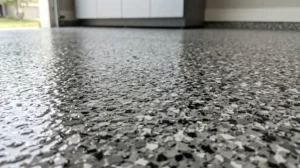
A decorative flake broadcast is not merely aesthetic—it is a functional armor layer. Broadcasting vinyl color chips to complete rejection (approximately 0.15 to 0.20 lbs of flake per square foot) builds total system thickness from a fragile 3 mils up to 25–35 dry mils.
This dense multi-layer flake composite acts as a thermal buffer, absorbing and dissipating the concentrated heat of vehicle tires before thermal energy can reach the concrete-resin bond line.
4. Aliphatic Polyaspartic Clear Topcoat
The final defense against hot tire pickup is an aliphatic polyaspartic polyurea clear coat. Polyaspartic coatings possess dense cross-linked molecular structures with thermal deflection limits exceeding 300°F—more than double the maximum operating temperature of highway vehicle tires.
Tire plasticizers cannot penetrate or soften an aliphatic polyaspartic film. When parked tires cool down overnight, no chemical migration occurs. The tire releases freely from the smooth, non-porous topcoat with zero pulling, tearing, or residue transfer.
Commuter Driving and High-Risk Zones on the Treasure Coast
Hot tire pickup strikes hardest in areas with high daily commuter mileage and intense afternoon heat:
- Port St. Lucie (Tradition, Becker Biltmore, Torino): Thousands of residents commute daily on I-95 or Florida’s Turnpike to Palm Beach County. Vehicles returning from a 45-minute continuous 70-mph highway drive transfer maximum frictional tire heat onto residential garage slabs.
- Stuart & Palm City: Waterfront homeowners towing heavy center-console boats, work trailers, or heavy SUVs put extreme downward load pressure on garage floors. Heavy vehicle weights compound high tire heat, accelerating tire pickup on inferior waterborne sealers.
- Jensen Beach, Hobe Sound & Fort Pierce: Garages subject to tracking in fine coastal silica sand face a double threat. Sand grains trapped under hot tires act as abrasive cutting teeth under soft epoxy paints, scouring the coating off down to bare aggregate.
- Vero Beach: Luxury collector garages, performance sports cars, and low-profile performance tires feature softer, stickier rubber compounds with higher plasticizer concentrations, requiring commercial polyaspartic topcoats to prevent tire sticking.
Stop Tire Marks and Peeling Concrete Permanently
Rolling on hardware store floor paint inevitably leaves bare tire tracks and peeling grey film stuck to your tires. Port St. Lucie Epoxy Flooring installs commercial-grade hybrid epoxy and polyaspartic floor systems that eliminate hot tire pickup, survive Florida groundwater pressure, and resist coastal salt air across Port St. Lucie, Stuart, Palm City, Jensen Beach, Vero Beach, Hobe Sound, and Fort Pierce. To fix an existing hot-tire failure or install a lifetime garage coating, book your site evaluation on our contact page.