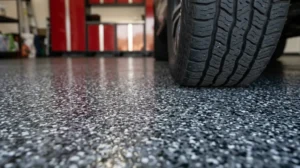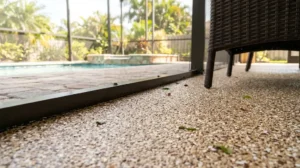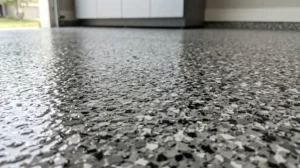
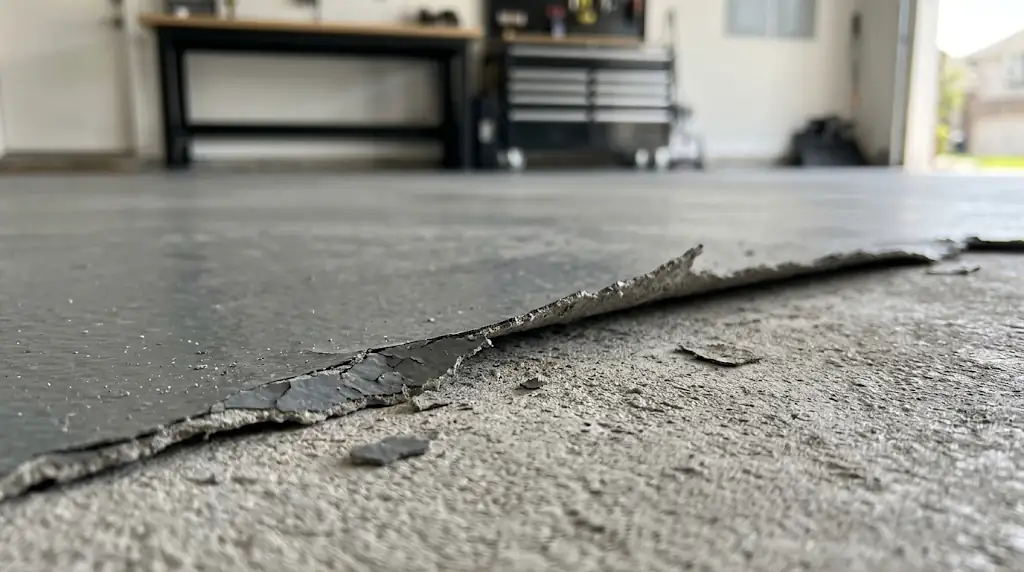
DIY garage floor epoxy peels on Treasure Coast homes because chemical acid etching fails to open hard-troweled concrete pores and water-based store-bought kits lack the film thickness and moisture vapor barriers needed to resist Florida’s shallow water tables and extreme tire heat. Without mechanical diamond grinding and dedicated moisture mitigation primers, subterranean hydrostatic pressure and hot tire plasticizer migration shatter the fragile chemical bond within 6 to 18 months.
The Mechanical Reality: DIY Kits vs. Professional Floor Chemistry
Waterborne epoxy kits sold at big-box home improvement stores are decorative paints modified with resin, not industrial coatings. The physical and chemical differences between DIY boxed kits and commercial multi-layer installations dictate whether a coating survives coastal Florida conditions:
| Metric / Specification | Big-Box Retail DIY Kits | Commercial Multi-Layer System |
| Active Solids Ratio | 40% – 50% solids (50%+ evaporates away) | 100% solids epoxy base + aliphatic polyaspartic |
| Finished Dry Film Thickness | 2 to 3 mils (thickness of a sheet of paper) | 25 to 35 mils (heavy-duty structural armor) |
| Surface Profile Standard | ICRI CSP 1 (Smooth, inadequate bite) | ICRI CSP 2 to 3 (Open, sandpaper-rough mechanical anchor) |
| Substrate Surface Prep | Muriatic acid wash or citric crystals | Industrial planetary diamond grinding with HEPA extraction |
| Hydrostatic Resistance | 0 to 3 lbs / 1,000 sq ft MVER | 15 to 25 lbs / 1,000 sq ft MVER (ASTM F3010) |
| Tensile Adhesion Strength | <150 psi (Fails at concrete surface) | >400 psi (ASTM D4541, concrete fractures before resin) |
| Tire Heat Resistance | Softens at 120°F – 130°F | Thermally stable past 300°F |
| Average Failure Window | 6 to 18 months in South Florida | 15 to 20+ years of active service |
4 Root Causes of DIY Epoxy Failure on the Treasure Coast
Every peeling DIY garage floor in Martin, St. Lucie, and Indian River counties fails due to one or more predictable environmental and mechanical stressors.
1. Acid Etching Destroys Florida Concrete Instead of Prepping It
DIY kits instruct homeowners to clean the floor with muriatic acid or dry citric acid powder mixed with water. This process fails on Treasure Coast slabs for three critical reasons:
- Inadequate surface profiling: Power-troweled concrete slabs in master-planned communities across Port St. Lucie have dense, slick, machine-compacted surfaces. Acid etching merely dissolves superficial surface calcium without profiling the structural aggregate beneath.
- Adding liquid water to saturated concrete: Pouring gallons of water onto a Florida garage floor drives moisture deep into concrete aggregate already holding high humidity. Trapping that newly introduced water under an epoxy coat causes immediate vapor blisters.
- Acid salt residues: Acid reacting with concrete leaves behind unreacted chemical salts. Unless neutralized perfectly and vacuumed dry with commercial extractors, these salts prevent chemical bonding, causing the new paint to pull away in broad sheets.
2. High Groundwater Tables and Capillary Hydrostatic Pressure
The Treasure Coast sits on flat terrain with high seasonal water tables fed by the Atlantic coastal ridge, the St. Lucie River basin, and extensive local canal networks. Unsealed concrete acts as a continuous capillary pump.
As groundwater evaporates beneath the slab, it creates moisture vapor emission rates (MVER) that consistently exceed 6 to 12 lbs per 1,000 square feet per 24 hours under ASTM F1869 testing. DIY water-based epoxies offer zero moisture vapor suppression. When rising water vapor hits the underside of the thin paint film, hydrostatic pressure builds until the paint blisters, discolors, and pops off the substrate.
3. Hot Tire Plasticizer Migration
During Florida summers, road asphalt temperatures in Stuart, Palm City, and Fort Pierce consistently exceed 145°F. Commuting on Interstate 95 or Florida’s Turnpike generates extreme frictional heat inside automotive tires.
Automotive tire manufacturers add polymer plasticizers to rubber compounds to prevent tires from stiffening. When a vehicle pulls into a garage after a highway drive:
- The heat from the tires transfers directly into the floor.
- Heat softens the thin resin matrix of DIY epoxy (which has a low heat deflection temperature).
- The tire plasticizers interact chemically with the softened paint film, bonding the rubber to the paint.
- As tires cool and contract overnight, they pull the thin DIY coating directly off the concrete, leaving bare tire tracks down to the raw slab.
4. Thin Film Thickness and High Solvent Evaporation
Store-bought epoxy kits contain roughly 50% to 60% carrier solvents or water. When rolled onto a floor at 4 to 6 wet mils, over half the material volume evaporates directly into the atmosphere during the drying cycle.
The homeowner is left with a dry film thickness of barely 2 to 3 mils. A film this thin has zero structural tensile strength, cannot bridge microscopic hairline shrinkage cracks, and chips away under minor physical impacts like dropped tools, metal ladders, or dragged trash cans.
Local Slab Challenges Across the Service Area
The mechanism of DIY failure varies across regional developments depending on build era and geographical location:
- Port St. Lucie (Tradition, Torino, Becker): Rapid residential construction features tight, machine-troweled 4-inch slabs. Homeowners attempting DIY acid etching discover the acid beads up and washes away without opening the tight slab surface, leading to complete bond failure within months.
- Stuart & Palm City: Waterfront lots along the North and South Forks of the St. Lucie River experience shallow water tables that fluctuate rapidly during tropical rainy periods. DIY epoxies without industrial moisture barriers bubble from bottom-up hydrostatic water pressure.
- Jensen Beach & Hobe Sound: Proximity to the ocean and Indian River Lagoon means sustained ambient humidity above 80%. DIY amine-cured epoxies suffer from “amine blushing” during the cure phase, developing a greasy surface film that turns dull, sticky, and yellow.
- Fort Pierce & Vero Beach: Established homes with older slabs often contain deep oil and grease deposits from years of automotive parking. Acid etching cannot emulsify embedded motor oil. Without mechanical grinding and deep-cleansing degreasers, DIY epoxy rolled over petroleum-stained aggregate peels immediately.
The Correction: How to Remediate a Failed DIY Floor
A failed, peeling DIY paint job cannot simply be painted over. Adding a new layer of paint on top of a failing base results in both layers peeling together.
Professional restoration requires:
- Mechanical stripping: Running industrial planetary grinders equipped with coarse diamond-segment tooling or polycrystalline diamond (PCD) scrapers to completely shave off the failed DIY paint and expose clean, virgin concrete aggregate.
- Moisture testing: Verifying internal relative humidity using ASTM F2170 probes to determine whether hydrostatic pressures require dedicated vapor-mitigation primers.
- Deep crack and spall reconstruction: Routing out slab fissures and repairing them with high-strength structural polyurea crack fillers rather than cheap latex patch compounds.
- Installing a commercial hybrid floor: Applying a 100% solids epoxy moisture vapor barrier, an edge-to-edge decorative vinyl flake matrix, and an aliphatic polyaspartic clear topcoat.
Restore Your Garage Floor with Commercial Engineering
Scraping, acid-washing, and reapplying box kits leads to endless maintenance cycles and wasted expense. Port St. Lucie Epoxy Flooring mechanically removes failed coatings using heavy diamond grinding equipment, stops groundwater hydrostatic pressure, and installs commercial-grade garage floor systems engineered for South Florida across Port St. Lucie, Stuart, Palm City, Jensen Beach, Vero Beach, Hobe Sound, and Fort Pierce. To strip your peeling floor and replace it with a permanent surface, reach out directly through our contact page.