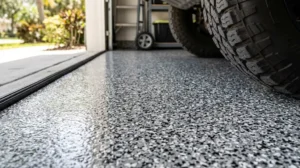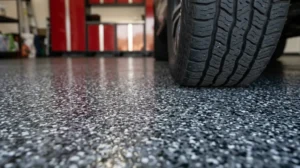
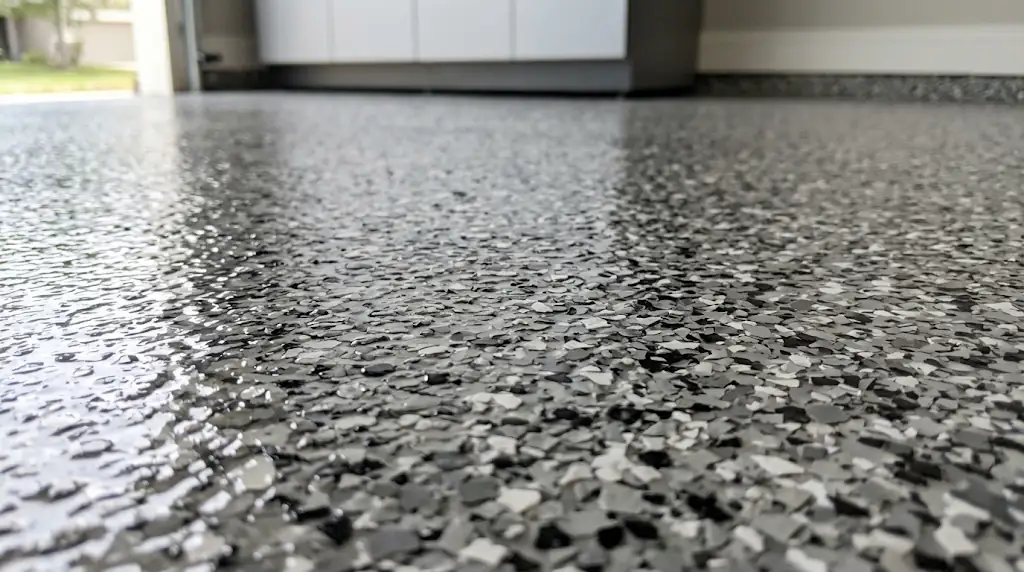
Professional epoxy garage floor coating on the Florida Treasure Coast costs between $4.50 and $12.00 per square foot installed. For a standard two-car garage measuring 400 to 500 square feet, local homeowners pay an average total between $2,200 and $4,800 depending on concrete slab preparation, moisture vapor barriers, and topcoat chemistry.
Treasure Coast Epoxy Flooring Pricing Breakdown
Garage sizes across St. Lucie, Martin, and Indian River counties range from compact single-bay garages in older developments to expansive three-car layouts common in master-planned communities like Tradition in Port St. Lucie.
| Garage Size | Square Footage | Basic Solid Color ($4.50 – $6.00/sq ft) | Full Decorative Flake ($6.00 – $8.50/sq ft) | Premium Metallic / Polyaspartic ($9.00 – $12.00/sq ft) |
| 1-Car Garage | 200 – 250 sq ft | $1,100 – $1,500 | $1,500 – $2,125 | $2,250 – $3,000 |
| 2-Car Garage | 400 – 500 sq ft | $1,800 – $3,000 | $2,400 – $4,250 | $3,600 – $6,000 |
| 2.5-Car / Tandem | 600 – 650 sq ft | $2,700 – $3,900 | $3,600 – $5,525 | $5,400 – $7,800 |
| 3-Car Garage | 750 – 900 sq ft | $3,375 – $5,400 | $4,500 – $7,650 | $6,750 – $10,800 |
Solid color applications deliver an industrial aesthetic suitable for standard utility rooms and light workshop use. Multi-layer full broadcast flake systems dominate residential installations across Port St. Lucie and Stuart because vinyl color chips provide slip resistance, disguise minor concrete imperfections, and handle heavy daily traffic. Metallic designer systems require multi-pigment artistic spreading and high-clarity clear coats, creating a marble finish suited for luxury collector garages in Jupiter Island, Vero Beach, and Palm City.
4 Cost Drivers Specific to the Treasure Coast
Every concrete floor in South Florida encounters severe environmental stresses that directly influence project estimates.
Total Cost = Base Mechanical Prep + Moisture Vapor Barrier + Body Coat + UV Clear Topcoat
1. Concrete Moisture Vapor Emission (MVER)
The Treasure Coast sits atop a shallow, sandy aquifer where water tables rest inches below ground during the summer rainy season. Unsealed concrete acts like a rigid sponge, pulling groundwater upward via capillary action.
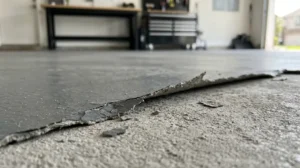
When moisture vapor pushes through the slab, hydrostatic pressure cracks and debonds low-grade epoxy coatings within 6 to 18 months. Slabs lacking a continuous underslab vapor retarder conforming to ASTM E1745 standards require a specialized 100% solids epoxy moisture vapor barrier primer.
- Cost impact: Adds $1.00 to $2.00 per square foot. Skipping this layer on high-moisture Florida slabs leads to bubbling and catastrophic delamination.
2. Mechanical Diamond Grinding vs. Acid Etching
DIY big-box floor kits suggest muriatic acid etching because acid is cheap. Acid etching fails on coastal concrete:
- It does not reliably open the pores of machine-troweled slabs.
- It injects gallons of additional water directly into concrete already holding high humidity.
- It leaves acidic chemical residue that weakens chemical adhesion.
Professional installations use heavy rotary diamond grinders hooked to HEPA-filtered vacuum extractors. Diamond tooling mechanically removes the weak laitance layer, smooths high spots, and produces an open Concrete Surface Profile (CSP) 2 or 3 benchmarked by the International Concrete Repair Institute.
- Cost impact: Diamond grinding represents roughly 40% of professional labor costs, preventing premature floor failures.
3. Coastal Salt Air and Ambient Humidity
Air relative humidity across Jensen Beach, Fort Pierce, and Hobe Sound regularly exceeds 80%. High ambient humidity forces water into the chemical curing reaction of cheap amine-cured epoxies, leading to “amine blush”—a greasy waxy film that prevents topcoat adhesion. Commercial installers use high-solids, moisture-tolerant polymers formulated specifically for humid tropical marine climates.
4. UV Stability and Clear Polyaspartic Topcoats
Epoxy resin possesses exceptional tensile adhesion to prepared concrete, but standard aromatic epoxies turn yellow and brittle under sunlight. Florida garages experience high UV exposure through open garage doors, bay windows, and golf-cart breezeways.
A high-performance system pairs an epoxy basecoat with an aliphatic polyaspartic or polyurethane clear topcoat. Polyaspartic topcoats offer:
- Total UV resistance without ambering or chalking.
- 3x to 4x higher scratch and abrasion resistance than epoxy alone.
- Resistance to hot tire plasticizer migration (the chemical process that pulls cheap paint off garage floors under hot car tires).
- Cost impact: Polyaspartic clear coats add $0.75 to $1.50 per square foot over single-stage epoxy systems, but extend floor life from 3 years to over 15 years.
DIY Box Kits vs. Professional Multi-Layer Systems
Hardware store epoxy paint kits advertise low upfront costs, but their chemistry and lifespan differ fundamentally from commercial-grade coatings.
| Feature | DIY Water-Based Epoxy Kits | Professional Multi-Layer System |
| Material Cost | $1.50 – $3.00 / sq ft | $4.50 – $12.00 / sq ft (Installed) |
| Solids Content | 40% – 50% solids (evaporates thin) | 100% solids epoxy + aliphatic polyaspartic |
| Coating Thickness | 2 – 4 dry mils | 20 – 35 dry mils |
| Surface Prep Method | Chemical acid etching | Industrial diamond grinding (CSP 2–3) |
| Moisture Vapor Resistance | None (Fails above 3 lbs/1,000 sq ft) | Up to 15–20 lbs/1,000 sq ft hydrostatic tolerance |
| Hot Tire Pickup Resistance | Low (Tires peel coating in summer) | Impervious to tire plasticizers and heat |
| Expected Lifespan | 1 to 3 years | 15 to 20+ years |
Regional Service Cost Breakdown: St. Lucie, Martin, and Indian River
Installation costs remain consistent across our service footprint, with minor site-specific adjustments based on slab age and elevation:
- Port St. Lucie (34952, 34953, 34983, 34986, 34987): Fast-growing master-planned communities like Tradition and Torino feature newer 4-inch slabs. New concrete requires at least 28 to 30 days of cure time before coating, alongside moisture testing to confirm water migration has stabilized.
- Stuart and Palm City (34990, 34994, 34997): Riverfront properties along the St. Lucie River and older homes in downtown Stuart often have unsealed slabs without vapor barriers underneath. Moisture mitigation primers are standard for these installations.
- Jensen Beach and Hobe Sound (34957, 33455): Coastal properties near the barrier islands require UV-stable polyaspartic topcoats to endure coastal sunlight, salt fog, and outdoor recreation traffic.
- Fort Pierce and Vero Beach (34947, 34950, 32960, 32963): Properties in citrus agricultural zones or historic downtown neighborhoods feature older, oil-stained slabs. Deep oil degreasing and pit filling add minor prep labor before grinding starts.
Get an Accurate Quote for Your Treasure Coast Garage
Every concrete slab presents a different profile of moisture levels, aggregate hardness, and surface damage. Port St. Lucie Epoxy Flooring performs full mechanical diamond grinding, moisture vapor testing, and installs commercial-grade multi-layer coatings across Port St. Lucie, Stuart, Palm City, Jensen Beach, Vero Beach, Hobe Sound, and Fort Pierce. For exact pricing tailored to your floor condition, view our service details and request a fast quote through our contact page.