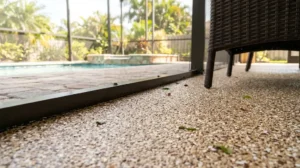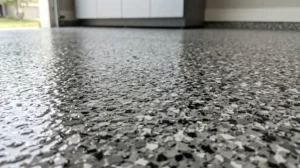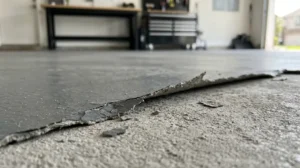
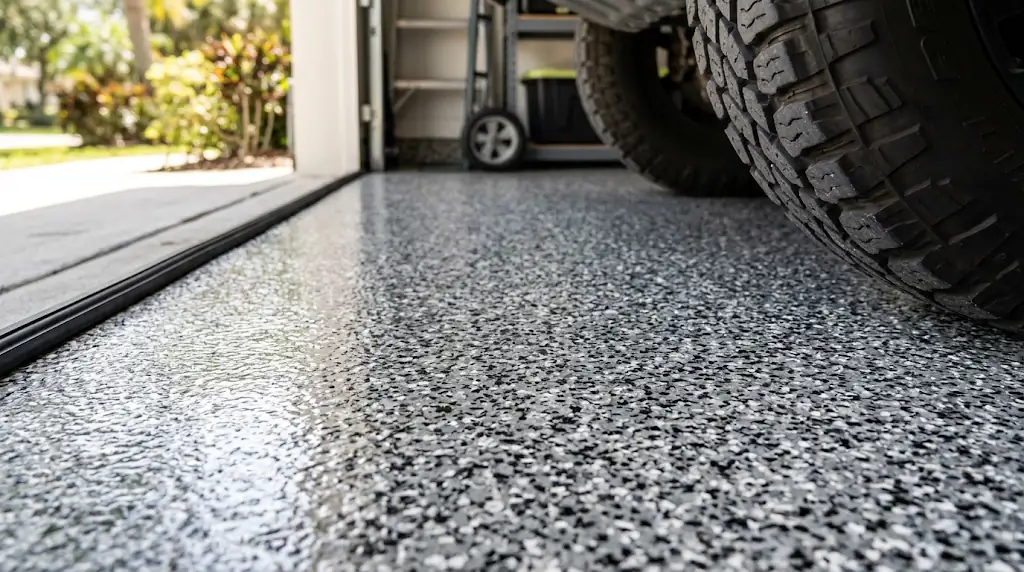
A professionally installed epoxy flooring system in South Florida lasts between 15 and 20 years in residential garages and up to 10 to 15 years in high-traffic commercial environments. Longevity depends entirely on diamond-ground substrate preparation, an integrated subterranean moisture barrier, and an aliphatic polyaspartic clear topcoat that shields the base coat from intense coastal heat and UV degradation.
Lifespan by Floor System Type in South Florida
Concrete coatings face far higher degradation rates in South Florida than in temperate regions. High groundwater levels, salt air, and asphalt surface heat accelerate floor failure in sub-standard systems.
| Coating System Type | Dry Film Thickness | Heat & Tire Resistance | Sub-Slab Moisture Defense | South Florida Lifespan | Primary Failure Mode |
| Retail Waterborne Epoxy Kit | 2 – 3 mils | Softens at 120°F | None (Fails above 3 lbs MVER) | 1 to 2 Years | Hot tire pickup, edge peeling, blistering |
| Single-Stage Solid Color Epoxy | 8 – 12 mils | Softens at 140°F | Low to Moderate | 3 to 5 Years | UV yellowing, surface scratching, dulling |
| Commercial Epoxy Base + Full Flake | 18 – 22 mils | Resistant up to 180°F | Moderate (Up to 8 lbs MVER) | 7 to 10 Years | Surface abrasion, topcoat ambering |
| Commercial Multi-Layer Hybrid System | 25 – 35 mils | Stable past 300°F | High (Up to 20+ lbs MVER via ASTM F3010) | 15 to 20+ Years | None; gradual micro-abrasion over decades |
4 Environmental Factors That Dictate Floor Longevity
In coastal communities throughout Martin, St. Lucie, and Indian River counties, four regional climate mechanisms dictate whether a floor lasts two years or twenty.
1. Concrete Moisture Vapor Emission (Hydrostatic Pressure)
South Florida sits on porous limestone and sand with shallow groundwater tables. When summer rainstorms saturate the soil, water vapor migrates upward through the concrete slab via capillary action.
If a coating lacks an industrial moisture vapor barrier primer, rising hydrostatic pressure breaks the chemical bond between the resin and the concrete. Water vapor accumulates under the coating, causing osmotic blistering and peeling within 12 to 24 months. Professional systems utilize high-solids moisture mitigation primers that anchor deep into concrete pores, resisting vapor pressures up to 20 to 25 pounds per 1,000 square feet under ASTM F1869 testing.
2. Hot Tire Plasticizer Migration
During summer months along the Treasure Coast, road asphalt temperatures consistently exceed 145°F. Vehicles commuting on Interstate 95 or Florida’s Turnpike build intense heat within their tire compounds.
When a hot vehicle parks on a garage floor:
- The contact patch transfers extreme heat into the coating.
- In lower-tier epoxies, heat softens the resin matrix.
- Petroleum-based plasticizers in the tire rubber leach into the softened resin, fusing the two surfaces.
- When the tires cool and contract, the tire peels the coating off the slab.
Commercial hybrid systems prevent hot tire pickup by sealing the epoxy base beneath an aliphatic polyaspartic topcoat with a high thermal transition temperature, preventing tire bond formation up to 300°F.
3. Solar Ultraviolet Radiation (UV) Breakdown
Garages in Port St. Lucie, Stuart, and Vero Beach receive substantial direct and reflected solar exposure. Epoxy is an aromatic polymer containing molecular bonds that break down when exposed to ultraviolet light.
Unprotected epoxy coats turn yellow, chalk, and lose tensile strength within 1 to 2 years of daily sun exposure. High-longevity floor installations prevent UV degradation by locking the epoxy primer underneath a dense broadcast of vinyl chips and capping it with a 100% UV-stable aliphatic polyaspartic shield that remains optically clear indefinitely.
4. Coastal Silica Sand and Salt Abrasion
Garages in coastal barrier island towns like Jensen Beach, Hobe Sound, and Vero Beach encounter constant abrasion from windblown silica sand and coastal salt crystals tracked in by vehicles and footwear. Coarse sand acts like 60-grit sandpaper under vehicle tires. Polyaspartic topcoats achieve exceptional abrasion ratings under ASTM D4060 Taber abrasion tests (losing just 12 to 15 milligrams of material per 1,000 cycles), outlasting standard clear epoxies threefold.
Maintenance Schedule to Ensure a 20-Year Lifespan
Commercial-grade multi-layer floors are non-porous and resistant to petroleum fluids, but routine maintenance guarantees the full 15- to 20-year performance window:
- Weekly: Sweep or blow out loose dirt, coral dust, and coastal silica sand using a soft-bristle broom or leaf blower to prevent surface grit grinding.
- Monthly: Mop the surface using clean water and a pH-neutral cleaner. Avoid acidic cleaners, citrus concentrates, and high-concentration bleach solutions that leave chemical films.
- Immediately: Wipe up caustic automotive fluids like brake fluid, battery acid, and transmission fluid. While chemical-resistant polyaspartics repel fluids, pooling corrosive fluids over several days should be avoided.
- Year 10 to 12 (High-Traffic Commercial Garages): High-traffic commercial workshop floors subject to forklift paths or steel-wheeled floor jacks can be lightly abraded and resealed with a single fresh clear polyaspartic topcoat, restoring complete gloss and extending floor life another decade without concrete re-grinding.
Regional Longevity Realities Across the Treasure Coast
Substrate conditions and property usage vary across our primary service territory:
- Port St. Lucie (34953, 34986, 34987): Master-planned communities in Tradition and Torino feature fast-growing families and daily long-distance highway commuters. Slabs require heavy-duty polyaspartic topcoats to eliminate hot tire pickup from daily highway commutes on I-95 and Florida’s Turnpike.
- Stuart & Palm City (34990, 34997): Proximity to the St. Lucie River and tidal waterways produces slabs with high internal moisture saturation. Slabs require comprehensive mechanical preparation benchmarked to ICRI concrete surface profile 2 (CSP 2) and moisture-mitigating base primers to achieve a 20-year lifespan.
- Jensen Beach & Hobe Sound (34957, 33455): High ocean salt spray and barrier island humidity require completely non-porous topcoats that seal aggregate against chloride-induced concrete pitting and efflorescence.
- Fort Pierce & Vero Beach (34947, 32963): Older historical slabs and rural properties with light equipment parking (boats, trailers, tractors) demand thick 25–35 mil broadcast flake systems that resist impact gouging and heavy tool drops.
Invest in Permanent Concrete Protection
A garage floor coating in coastal Florida should be an investment completed once, not a peeling chore reapplied every other summer. Port St. Lucie Epoxy Flooring engineers commercial-grade hybrid flooring systems built specifically to resist sub-slab groundwater pressure, intense automotive heat, and coastal UV rays across Port St. Lucie, Stuart, Palm City, Jensen Beach, Vero Beach, Hobe Sound, and Fort Pierce. To inspect your concrete slab and receive a transparent project estimate, reach out through our contact page.